
Exercises
Jan 09 – Silophone

Exercise B
In deciding to choose a unique example of “urban computing” in my life, it was tempting to pick the mobile cell phone or even the Nintendo DS which is equipped with: A camera, a slide controller, WiFi USB connector, a browser, headset, rumble pak (for character sensor vibrations) and a dual screen. Tempting, although I ended up with something quite different.
The Silophone project. The readings in fact strongly guided me to this example. There was a lot of what I considered more artistic examples in the readings that dealt with light, GPS tracers that resulted in several unsteady line distributions, or even the Living Glass that was both delicate and informative. I find it hard to separate the commercial/corporate aspect of an urban computing example versus something that is artistic and the knowledge or use it gives to a user will do more good than harm. For this reason I may start dividing my examples on scales from 1-10 (in future blogs), where 10 is completely a consumer/commercial product and 1 is the essence of “art” and goodness.
Going back to my example, I choose Silophone for the reason that it is a project that involves space, sound and user interaction. Silophone
It is interesting, because it involves the mobile phone or a device with similar connectivity, to join other users in creating their own sounds in the Silo’s. Users can then upload various sounds created from a device that allows them internet access. People may use these sounds for projects or listen to them while doing work/relaxing. The abandoned Silo’s have also been put to use in a positive way that allows users to control the input but does not necessarily control them.
I am beginning to understand the difference between art/commercial (i.e. cell phones, face book) and art/goodness projects from these readings, which becomes very effective in my choices as an artist. I want people to really think about the questions I raise in my work that are useful long-term instead of immediately (i.e. for the benefit of the short and long term future, as opposed to the very short term future). I understand Silophone to do something of the sort, as a close example of an urban computing device that I have experienced.
 Subjective View
 Objective View
Jan 16 – Tea Table
Exercise A
Below I have attached the original concept of the side table sketched in class, along with the new version of The Tea Table.
 A Sketch of The Side Table
Exercise B
The Tea Table – A ubiquitous technology created in reference from Allan Chochinov’s “Creating gesture or Vapid prototyping; the importance of fictional products”, and Cabra and Nelson’s “New Scandinavian Design”. Chochinov’s article ensures that there is in fact a market for designers to create fictional products. It is important for designers to continue to create and post their conceptual designs, both for themselves as much for others artists. Cabra and Nelson take Chochinov’s article one step further by creating a book in which various designs of both regular and ubiquitous technologies have been created in a unique and (for the most part) sustainable way.
For this exercise my chosen words were: side table (object), burn (verb) and Fallin by Alicia Keys (song), in which I have devised the concept of The Tea Table. It is not as unique as the Scandinavian Designs, though it puts forth its own charm.
The invention – is a wooden/glass/aluminum side table with connecting legs and two tubes made out of wood (of which the interior is metal or a hard plastic). The table has two buttons crafted in the form of a circle on either side of the board. It is meant to be pressed manually. One button (the Herbal Sensor) is devised to release a small amount of tea leaves (you stack the tea yourself in the unit/container) into your tea cup. The second button (the Burn Sensor) is devised to heat and release hot water into your cup.
When a button is pressed – a few moments prior to the descending tea leaves or the boiled water (ready to be poured) the main chorus of Alicia keys’ song Fallin plays as a warning to the user to hold out his/her mug. (The table is equally equipped with a sound chip.) See above image for details.
 Concept Art
–
–
Jan 23 – Tea Table Gone Wild!
January 28, 2008 (week of Jan 23 – Jan 30).
The Tea Table has gone wild.
So wild, in fact, that it has aged to fit an obscure contraption of an invention of the late 1950’s. Attached to the left is an old advertisement of an invention known as “The Tea Table” in which a young lady in the bottom right is cheerfully holding a…tea cup. For the purpose of the showing I have managed to obtain a clear copy of the image without the young lady. I have posted it below.
Regards, The Author.
Yes indeed! The Tea Table has gone wild. I have the clean and clear version on my desktop of the information bubbles on the original image presented last week. It is without a doubt more amusing and challenging (not to mention time consuming) to attempt a re-enactment of a late 1950’s poster. Personally, I did not choose the right picture of a 1950’s woman to conform to my image, however due to time constraints (and serious lack of 1950’s images on the internet – who would have thought?), this may very well be my final choice.

Tea Table Advertisement (estimated 1950’s)

Scientific Explanation

Steam from the boiling water
Jan 30 – Documenting the Space
The space I have chosen for my project can be found in the underground city, between Places Desjardins and Guy Favreau. It is a tunnel. I have also included video.
Video 1: People and the Space

The Photographer
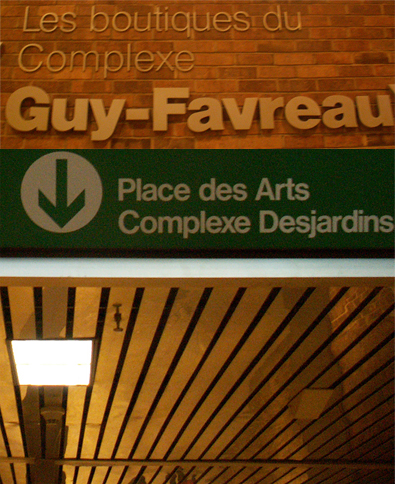
Location

Going inside the space

Continuing the journey

Interesting views of the space

Different angles

The tunnel can be creepy too…

A woman walking through the space

A beautiful reflection

a collaged piece of the tunnel


The beauty of movement

Continued study of movement

Caught in action shot :movement
Feb 13 – Maps
The motion maps I have posted below are more like sketches to the concept of mapping. I mapped movement in a single space, and I have created a more literal version of what we perceive as a typical map. I plan to re-create one image (a typical map sequence from Places-des-Arts connecting to Place D’Armes. In this map I will take documented image stills of my route from one end to the other, then create a series of images that will become the road or map itself. I think this will be very interesting, because without having to necessarily point out a location, the viewer may recognize fragments of a space leading to my project area. I would also like to note that the second image posted is representational of my concept for the final project, in creating a Train like architectural template for the passage.

It could be found posted on a wall…

Design interior of a train as my space

Motion captured by paint

Motion as a collage
Feb 20 – Version 1 of the 3 Maps
–

Poster Map

Train tracks mark the movement of people

(please click the name as it is too big to create a thumbnail in the system.)
Corrected Versions can be found in The Project section.
April 14 – Branding
This is a late entry in regards to the order of the project. However, it seemed appropriate to place my sketches in “exercises”, since it is just that.
Below I have posted some ideas for the branding of this project.

Logo & Sheet

Logo v.02

Concept Photos

More Concept Photos
 CART 453